2023/6/16
Share to:
Disposable Medical Underpads Buying Guide
Disposable medical underpads are widely used in hospitals, nursing homes, long-term care facilities and home healthcare. They provide an additional layer of protection for beds, mattresses, examination tables, wheelchairs and other surfaces that may come into contact with body fluids.
For medical distributors and wholesale buyers, choosing the right underpad involves more than comparing prices. Absorbency, dimensions, material construction, leakage protection and packaging all influence product performance and suitability for different markets.
This guide explains the key specifications to evaluate when sourcing disposable medical underpads and how to select products that match the needs of healthcare providers and end users.
1. What Are Disposable Medical Underpads?
Disposable medical underpads, also called disposable bed pads or patient underpads, are absorbent protective sheets designed to help manage moisture and protect underlying surfaces. They are commonly placed beneath patients during treatment, recovery or daily care.
Unlike reusable fabric pads, disposable underpads are generally intended for single use. After use, they can be removed and discarded according to the facility's waste management procedures.
Typical applications include:
Protecting beds and mattresses in hospitals and nursing homes.
Managing moisture during patient care and personal hygiene procedures.
Providing surface protection in examination and treatment areas.
Supporting daily care in long-term care facilities.
Protecting furniture and bedding during home healthcare.
The exact product requirements depend on the intended application, expected fluid volume, frequency of replacement and the preferences of the healthcare provider.
2. How Do Disposable Medical Underpads Work?
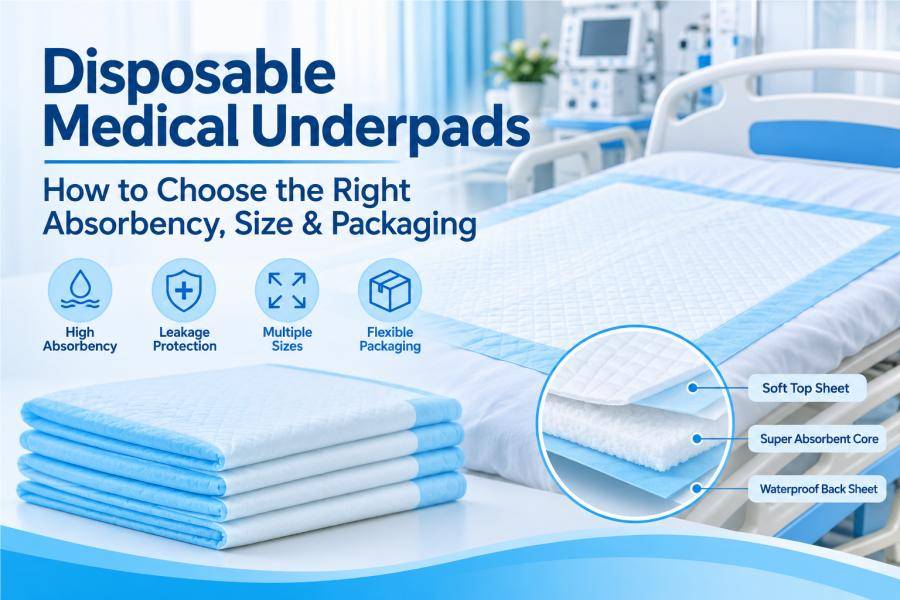
Most disposable medical underpads use a layered construction. Each layer has a different function, helping the product absorb liquid, distribute moisture and protect the surface underneath.
Top Sheet
The top sheet is the surface that comes into contact with the patient. It is commonly made from a soft nonwoven material designed to provide a comfortable contact surface and allow liquid to pass into the absorbent core.
Absorbent Core
The absorbent core collects and retains liquid. Depending on the product design, it may contain fluff pulp, absorbent polymer materials such as SAP, or a combination of materials. The composition and quantity of absorbent materials can affect the product's overall absorption performance.
Back Sheet
The back sheet is usually made from a plastic film or another liquid-resistant material. Its purpose is to help prevent liquid from passing through to the mattress, bed or other protected surface.
Some products may also include additional layers or bonding features to improve structural stability. Buyers should request product specifications and samples to understand the actual construction rather than assuming all underpads have the same design.
3. How to Choose the Right Absorbency
Absorbency is one of the most important factors when selecting disposable medical underpads. A product with insufficient absorption capacity may need to be replaced more frequently, while a higher-capacity product may not be necessary for every application.
Instead of choosing a product based only on its appearance or thickness, buyers should consider the expected liquid volume, usage duration and replacement frequency.
Light Absorbency Requirements
For applications involving relatively small amounts of liquid or short periods of use, a lighter absorbency option may be suitable. These products can be considered for routine surface protection and certain examination or personal care procedures.
Medium Absorbency Requirements
Medium absorbency products may be appropriate for general patient care where a balance between absorption performance, product thickness and cost is required. They can be evaluated for use in hospitals, nursing homes and home healthcare settings.
Higher Absorbency Requirements
For applications involving larger liquid volumes or longer periods between changes, buyers may need products with greater absorption and retention capacity. These products may use a different absorbent core design or a higher quantity of absorbent materials.
Absorbency labels such as light, medium and heavy are not necessarily standardized across manufacturers. When comparing suppliers, request measurable test results and clarify the testing method, sample size and conditions. Also distinguish between the amount of liquid a pad can absorb under test conditions and how well it retains liquid under pressure during actual use.
4. Selecting the Right Underpad Size
Underpad dimensions affect the area of protection, placement and suitability for different care environments. A small pad may be sufficient for localized protection, while a larger one may be more practical for covering a wider area of a bed or examination surface.
When selecting a size, consider the following factors:
Protected area: Determine how much of the mattress, bed or chair needs to be covered.
Patient positioning: Consider whether the pad needs to cover a localized area or provide wider protection during movement.
Application: Examination tables, hospital beds and wheelchairs may require different dimensions.
Handling: The pad should be practical for caregivers to position and replace.
Storage: Larger products may require more storage and shipping space.
For wholesale orders, buyers should confirm the finished product dimensions rather than relying on general size descriptions. If a standard size does not meet local market requirements, ask whether custom dimensions are available.
5. Key Materials and Product Specifications to Check
Two underpads with similar dimensions may perform differently because of their material composition and manufacturing design. Buyers should review the following specifications before placing a bulk order.
Material Composition
Check the top sheet material, absorbent core composition and back sheet material. Ask whether the core contains fluff pulp, SAP or other absorbent components, and confirm the material specifications for the exact product being quoted.
Absorption and Retention Performance
Ask for test data showing how much liquid the underpad absorbs and how well it retains liquid. A useful evaluation should consider both absorption speed and the possibility of liquid returning to the surface under pressure.
Leakage Protection
The back sheet should provide suitable liquid protection for the intended application. Buyers should also inspect the edges and overall bonding to check whether the product maintains its structure during normal handling and use.
Product Weight and Thickness
Product weight and thickness can help buyers understand differences in construction, but neither measurement alone proves absorption performance. Compare these specifications together with material composition and test results.
Surface Feel and Structural Stability
The top sheet should be appropriate for the intended patient-care environment. The pad should also remain sufficiently stable during placement and removal without easily separating or losing its shape.
6. Applications in Different Healthcare Settings
Disposable medical underpads are used in a range of healthcare and personal care environments. Understanding the application helps buyers select the right combination of size, absorbency and packaging.
Hospitals and Medical Facilities
Hospitals may use underpads during patient care, examinations, recovery and other procedures where additional surface protection is needed. Procurement teams should consider consistent specifications, reliable supply and packaging that supports efficient storage and distribution.
Nursing Homes and Long-Term Care Facilities
Long-term care environments may require underpads for regular daily use. Absorbency, comfort, ease of replacement and cost per use are important considerations when evaluating products for these settings.
Home Healthcare
For home care, underpads can help protect mattresses, chairs and other household surfaces. Convenient packaging and manageable product dimensions may be especially important for families and home care providers.
Examination and Treatment Areas
Medical practices and treatment facilities may use underpads as an additional protective layer on examination tables or other work surfaces. The required size and absorbency depend on the procedure and facility protocols.
7. Packaging Options for Wholesale and Bulk Purchasing
Packaging is an important part of disposable medical underpad sourcing. It affects storage, transportation, retail presentation and inventory management. The best packaging configuration depends on the buyer's distribution model and target market.
Individual or Small-Pack Packaging
Smaller packs may be suitable for retail distribution, pharmacies and home healthcare customers. They can be easier for end users to store and handle, depending on the pack design.
Bulk Packaging
Bulk packs are often considered by hospitals, care facilities and medical distributors purchasing larger quantities. Buyers should check the number of pieces per pack, packs per carton and carton dimensions before confirming an order.
OEM and Private Label Packaging
Importers and brand owners may require customized packaging with their own brand identity. Depending on the manufacturer's capabilities, customization may include printed bags, labels, carton markings and product specifications.
Before mass production, confirm the artwork, language requirements, barcode information, labeling details and packaging materials. Also request a final packaging sample or approved artwork proof to reduce the risk of errors.
8. How to Evaluate a Disposable Medical Underpad Supplier
Selecting a reliable supplier is just as important as choosing the product itself. For distributors and importers, supplier evaluation should cover product consistency, production capability, communication and order fulfillment.
Product specifications: Request detailed information about dimensions, materials, absorbency, product weight and packaging.
Samples and testing: Evaluate samples before placing a large order. Compare the actual product with the agreed specifications.
Quality management: Ask about the supplier's quality control procedures and the inspection process for incoming materials and finished products.
Production capacity: Confirm whether the supplier can support your expected order volume and delivery schedule.
Customization: Check the availability of custom sizes, packaging and private label services if required.
Export experience: Discuss shipping arrangements, export documentation and labeling requirements for your destination market.
Communication: A responsive supplier should be able to explain specifications clearly and provide updates throughout the order process.
Buyers should also confirm which regulatory, testing and documentation requirements apply to the product in their target market. Do not assume that a general company certificate automatically covers every product or intended use.
9. Common Purchasing Mistakes to Avoid
When sourcing disposable medical underpads, several common purchasing mistakes can lead to unnecessary costs or products that do not meet end-user expectations.
Choosing by price alone: A lower unit price may not represent better value if the product needs more frequent replacement.
Ignoring absorbency test methods: Absorbency figures from different suppliers may not be directly comparable unless the testing conditions are understood.
Ordering the wrong size: A product that does not cover the required area may reduce its practical value.
Overlooking packaging details: Unclear pack quantities and carton dimensions can affect inventory planning and shipping costs.
Skipping sample evaluation: Product samples help buyers check material feel, construction, dimensions and overall quality before committing to a bulk order.
Failing to confirm specifications: Important details should be documented and approved before production begins.
10. Frequently Asked Questions
What are disposable medical underpads used for?
Disposable medical underpads are used to protect beds, mattresses, examination tables, chairs and other surfaces from moisture and body fluids. They are commonly used in hospitals, nursing homes, long-term care facilities and home healthcare.
What materials are used in disposable medical underpads?
Many disposable underpads use a nonwoven top sheet, an absorbent core made with materials such as fluff pulp and/or SAP, and a liquid-resistant back sheet. Exact construction varies by manufacturer and product specification.
How do I choose the right absorbency level?
Consider the expected liquid volume, application, duration of use and replacement frequency. Request absorbency and retention test data from the manufacturer, because terms such as light, medium and heavy may differ between suppliers.
Are disposable medical underpads available in different sizes?
Yes. Underpads are available in different dimensions for various care environments. Buyers should select a size based on the area requiring protection and confirm the finished dimensions with the supplier.
Can medical underpads be customized for wholesale orders?
Depending on the manufacturer's capabilities, wholesale buyers may be able to request customized dimensions, absorbent construction, pack quantities and private label packaging. Confirm minimum order quantities, lead times and customization options before ordering.
What should I check before placing a bulk order?
Review the product dimensions, material composition, absorbency and retention performance, leakage protection, packaging configuration, quality control procedures and delivery arrangements. It is also advisable to evaluate samples before confirming a large order.
Quick Summary: Choosing the Right Disposable Medical Underpads
Absorbency: Match absorption and retention performance to the intended application and expected liquid volume.
Size: Choose dimensions that provide sufficient coverage for the bed, chair or examination surface.
Materials: Check the top sheet, absorbent core and liquid-resistant back sheet.
Performance: Review test methods, leakage protection and product construction rather than relying on appearance alone.
Packaging: Confirm pieces per pack, packs per carton and OEM or private label requirements.
Supplier: Evaluate samples, quality control, production capability and export support before placing a bulk order.
Looking for a Reliable Medical Disposable Products Supplier?
Choosing the right disposable medical underpads requires a clear understanding of product specifications and end-user requirements. For medical importers, wholesalers and distributors, working with a supplier that can provide consistent quality, clear product information and dependable order support is essential for long-term business.
Hefei Hongwei Medical Devices Co., Ltd. supplies a range of disposable medical and healthcare products for international markets. Contact our team to discuss your product requirements, packaging preferences and bulk purchasing needs.
Email: phyllis@honwaymed.com
Phone / WhatsApp: +86 15056901055
Website: www.honwaymed.com
Contact us to discuss your disposable medical product sourcing requirements and request a quotation.
News Center
Industry News


 WhatsApp
Send us your message
You can send an email asking for the price and detailed information of this product. We will reply you as soon as we receive your email